🚀 Building Production-Ready AI Agents with C# and .NET
Explore how C# and .NET can power production-ready AI agents using OpenAI, RAG, MCP, and AWS. Discover practical architecture, security, and scalability strategies for transforming AI capabilities into reliable enterprise solutions that deliver measurable business value.
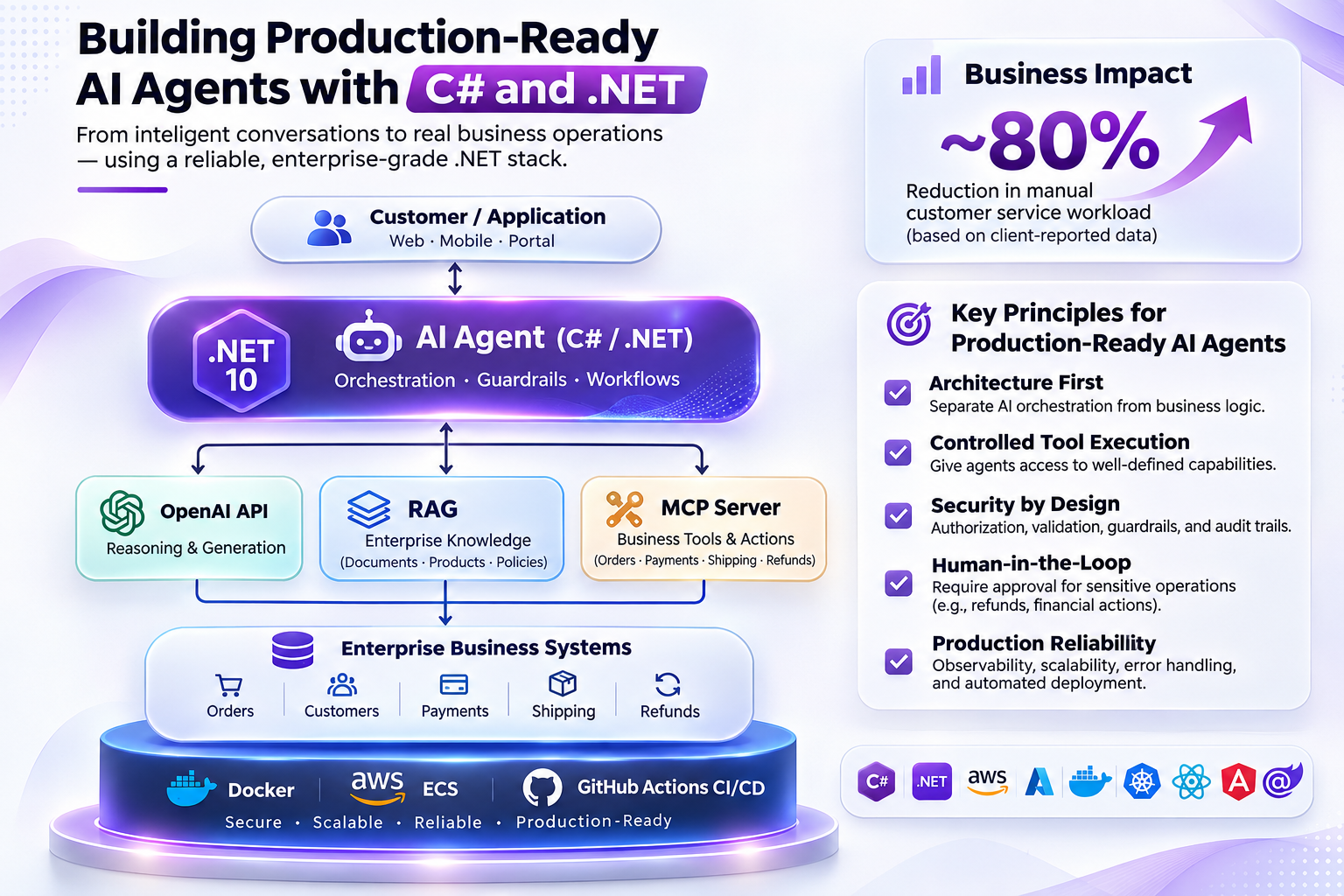
When people talk about AI engineering, Python is often the first language that comes to mind. But C# and .NET are also powerful choices for building enterprise-grade AI solutions.
Building an AI agent is relatively easy. Building one that is secure, scalable, reliable, and capable of handling real business operations is an entirely different challenge.
In one of my recent projects, I developed a production AI-powered customer service agent using:
🔹 .NET 10 and ASP.NET Core
🔹 OpenAI API
🔹 Retrieval-Augmented Generation (RAG)
🔹 Custom C# MCP Server
🔹 Human-in-the-Loop (HITL)
🔹 Docker and AWS ECS
🔹 GitHub Actions CI/CD
The solution goes beyond answering customer questions. It can interact with enterprise systems, manage orders, retrieve customer information, handle shipping requests, and initiate refund workflows with human approval.
The result? Approximately 80% reduction in manual customer service workload, based on client-reported operational data.
Here are five principles I believe are essential when building production-ready AI agents:
1️⃣ Architecture First — Separate AI orchestration from business logic.
2️⃣ Controlled Tool Execution — Give agents access to well-defined business capabilities, not unrestricted system access.
3️⃣ Security by Design — Implement authorization, input validation, guardrails, and audit trails.
4️⃣ Human-in-the-Loop — Require human approval for sensitive financial and business operations.
5️⃣ Production Reliability — Design for observability, scalability, error handling, and automated deployment.
AI doesn't replace traditional software engineering principles. It makes them even more important.
The real value is not simply connecting an application to an LLM. It's integrating AI into reliable enterprise systems that solve real business problems.
As a Senior Software Engineer, I'm excited about the intersection of .NET, cloud architecture, and AI engineering.
What's your preferred technology stack for building production-ready AI applications?
#DotNet #CSharp #SoftwareEngineering #AIEngineering #GenerativeAI #AWS #SoftwareArchitecture #MCP #RAG #CloudNative #OpenToWork